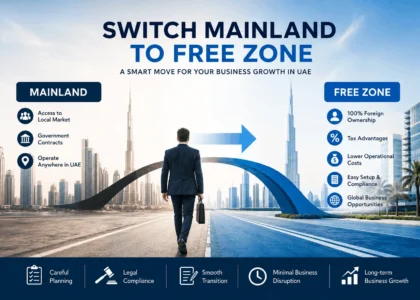
The United Arab Emirates has earned a reputation as one of the world’s most business-friendly destinations, attracting entrepreneurs, startups, SMEs, and multinational corporations from across the globe. One of the biggest reasons behind this success is the attractive tax environment offered by its Free Zones. Investors searching for 0% tax freezone UAE opportunities often wonder whether every Free Zone company automatically qualifies for zero corporate tax. While the answer is not always straightforward, understanding the UAE’s Corporate Tax framework can help businesses maximize their tax benefits while remaining fully compliant with local regulations.
Since the UAE introduced Corporate Tax, many misconceptions have emerged regarding Freezone taxation. Contrary to popular belief, the 0% Corporate Tax benefit is not guaranteed for every company. Businesses must satisfy specific eligibility requirements to retain this preferential tax treatment. In this guide, we’ll explain how UAE Free Zones maintain a 0% Corporate Tax rate, who qualifies, compliance obligations, and why Free Zones continue to be among the most attractive jurisdictions for global investors.
What is 0% Tax Freezone UAE?
Understanding the UAE Corporate Tax System
Corporate Tax is a direct tax imposed on the taxable profits of businesses operating in the UAE. The tax regime was introduced to align the country’s financial system with international standards while preserving its competitiveness as a global business hub.

The UAE Corporate Tax structure generally includes:
- 0% Corporate Tax on taxable income up to the applicable threshold.
- 9% Corporate Tax on taxable income above the threshold.
- Special tax incentives for qualifying Free Zone businesses.
The introduction of Corporate Tax has not eliminated the advantages of Free Zones. Instead, businesses that meet specific conditions can continue benefiting from the 0% tax freezone UAE framework.
Why UAE Free Zones Continue to Offer Tax Benefits
Purpose of UAE Free Zones
Free Zones were established to encourage foreign investment and support economic diversification. They provide investors with a business-friendly environment through simplified regulations, advanced infrastructure, and attractive financial incentives.
Major advantages include:
- 100% foreign ownership
- Easy company incorporation
- Full repatriation of capital and profits
- Modern office and warehouse facilities
- Efficient customs procedures
- International trade opportunities
- Potential eligibility for 0% tax freezone UAE benefits
These incentives make Free Zones highly attractive for companies engaged in global trade and international business.
Understanding the 0% Tax Freezone UAE Framework
Is Every Free Zone Company Tax-Free?
One of the biggest misconceptions among investors is that every Free Zone business automatically pays zero Corporate Tax.
This is not correct.
The UAE allows only qualifying businesses to benefit from the 0% Corporate Tax rate. Companies that fail to meet the required conditions may become subject to the standard Corporate Tax rate.
Therefore, understanding the 0% tax freezone UAE regulations before setting up your business is essential.
Who Qualifies for 0% Tax Freezone UAE?
Qualifying Free Zone Person (QFZP)
The UAE Corporate Tax Law introduces the concept of a Qualifying Free Zone Person (QFZP).
A company must satisfy several conditions to obtain and retain this status.
Key Eligibility Requirements
A qualifying business generally must:
- Be legally established within a recognized UAE Free Zone.
- Maintain adequate economic substance.
- Generate qualifying income.
- Comply with transfer pricing regulations.
- Maintain proper accounting records.
- Prepare audited financial statements where applicable.
- File Corporate Tax returns on time.
Meeting these conditions enables eligible businesses to benefit from the 0% tax freezone UAE regime.
What Is Qualifying Income?
1. Income Eligible for 0% Corporate Tax
- Not every type of income qualifies for preferential tax treatment.
- The UAE distinguishes between qualifying and non-qualifying income when determining Corporate Tax liability.
2. Business with Other Free Zone Companies
- Transactions between qualifying Free Zone entities generally remain eligible.
3. Export Activities
- International exports continue to receive favorable tax treatment.
4. Manufacturing Operations
- Industrial businesses operating from Free Zones often qualify.
5. Logistics and Warehousing
- Storage, shipping, freight forwarding, and logistics activities may qualify under specific circumstances.
6. Certain Professional Services
- Some commercial and professional services performed under qualifying conditions can also receive the benefits of the 0% tax freezone UAE framework.
Income That May Not Qualify
Understanding Non-Qualifying Income
Companies should carefully evaluate their revenue sources because not every activity qualifies for the 0% Corporate Tax rate.
Examples may include:
- Certain mainland business activities.
- Income from excluded sectors.
- Revenue generated outside qualifying activities.
- Transactions that fail to satisfy regulatory conditions.
A professional tax assessment is recommended for businesses with multiple income streams.
Economic Substance Requirements
Why Genuine Business Operations Matter
The UAE encourages real business activities rather than companies established solely to obtain tax benefits.
Businesses should demonstrate:
1. Physical Office
- A legitimate business location within the Free Zone.
2. Qualified Employees
- Staff capable of managing daily operations.
3. Active Business Management
- Management decisions should be made within the UAE.
4. Business Activities
- Core income-generating functions should occur inside the country.
Maintaining adequate economic substance is one of the most important requirements for preserving 0% tax freezone UAE eligibility.
Accounting and Financial Reporting
Importance of Accurate Financial Records
Proper bookkeeping is essential for Corporate Tax compliance.
Companies should maintain:
- Complete accounting records.
- Annual financial statements.
- Supporting invoices and contracts.
- Expense documentation.
- Revenue records.
- Audited financial statements where required.
Accurate financial reporting helps businesses demonstrate ongoing compliance with UAE tax regulations.
Transfer Pricing Compliance
1. Related Party Transactions
- Businesses dealing with related entities must comply with UAE transfer pricing regulations.
2. Arm’s Length Principle
- Related-party transactions should reflect fair market pricing.
3. Documentation
- Companies should maintain documentation supporting transfer pricing policies.
4. Reporting
- Required disclosures should be submitted within Corporate Tax filings.
Failure to comply with transfer pricing rules may affect eligibility for 0% tax freezone UAE benefits.
Corporate Tax Registration Is Mandatory
Zero Tax Does Not Mean Zero Compliance
Many investors mistakenly believe that companies enjoying a 0% Corporate Tax rate do not need to register.
This assumption is incorrect.
Businesses generally should:
- Register for Corporate Tax.
- Obtain a Corporate Tax registration number.
- File annual tax returns.
- Maintain accounting records.
- Meet filing deadlines.
- Retain supporting documentation.
Compliance remains mandatory regardless of the applicable tax rate.
Advantages of 0% Tax Freezone UAE
1. Why Businesses Choose Free Zones
- The UAE continues to attract international investors because of its competitive business ecosystem.
2. Lower Tax Burden
- Eligible companies can significantly reduce Corporate Tax expenses.
3. Global Market Access
- Free Zones support international trade through world-class logistics.
4. Foreign Ownership
- Investors enjoy complete ownership without requiring a local shareholder in most cases.
5. Simplified Regulations
- Company formation and licensing processes are generally faster than many international jurisdictions.
6. Modern Infrastructure
- Businesses gain access to premium offices, warehouses, ports, airports, and technology parks.
Popular Industries Benefiting from UAE Free Zones
1. Businesses That Commonly Choose Free Zones
- Several industries frequently establish operations within UAE Free Zones.
2. Trading Companies
- International import-export businesses.
3. Manufacturing
- Industrial production facilities.
4. Technology Companies
- Software development, AI, cybersecurity, and IT services.
5. E-commerce Businesses
- Cross-border online retail operations.
6. Consulting Firms
- Professional advisory and management consulting services.
7. Logistics Providers
- Shipping, freight, warehousing, and supply chain management.
These sectors often benefit significantly from the 0% tax freezone UAE framework when compliance requirements are satisfied.
Common Myths About Free Zone Corporate Tax
1. Every Free Zone Company Pays Zero Tax
- False.
- Only qualifying businesses receive the benefit.
2. Corporate Tax Registration Is Optional
- Incorrect.
- Registration and compliance remain mandatory.
3. All Income Is Tax-Free
- Not true.
- Only qualifying income receives the preferential tax treatment.
4. Free Zone Companies Never Pay Corporate Tax
- Some Free Zone businesses may become subject to the standard Corporate Tax rate if they fail to meet qualifying conditions.
How to Maintain 0% Tax Freezone UAE Status
1. Best Practices for Businesses
- Businesses should proactively manage compliance throughout the financial year.
2. Maintain Proper Records
- Accurate bookkeeping reduces compliance risks.
3. Understand Revenue Sources
- Identify qualifying and non-qualifying income.
4. Meet Filing Deadlines
- Submit Corporate Tax returns on time.
5. Conduct Genuine Business Operations
- Maintain sufficient economic substance.
6. Monitor Regulatory Changes
- Corporate Tax regulations may evolve over time.
7. Seek Professional Advice
- Consult experienced tax professionals for ongoing compliance.
Following these practices helps businesses retain the benefits of the 0% tax freezone UAE regime.
Common Mistakes Businesses Should Avoid
Compliance Errors That Can Be Costly
Avoid these common mistakes:
- Assuming every Free Zone company automatically qualifies.
- Ignoring Corporate Tax registration.
- Poor bookkeeping.
- Missing filing deadlines.
- Insufficient economic substance.
- Incorrect transfer pricing documentation.
- Misclassifying qualifying income.
- Failing to maintain audited financial statements where required.
Avoiding these mistakes helps preserve long-term tax advantages.
Frequently Asked Questions
1. Do all UAE Free Zone companies receive 0% Corporate Tax?
- No. Only companies meeting the requirements of a Qualifying Free Zone Person (QFZP) can benefit from the 0% tax freezone UAE framework.
2. Is Corporate Tax registration still required?
- Yes. Eligible companies must generally register for Corporate Tax and comply with filing obligations even if they qualify for a 0% tax rate.
3. Can a Free Zone company lose its tax benefits?
- Yes. Failure to meet regulatory requirements, maintain economic substance, or generate qualifying income may result in losing the preferential Corporate Tax treatment.
4. Is a Free Zone suitable for every business?
- Not necessarily. While Free Zones provide outstanding tax advantages, the right business structure depends on your target market, operational requirements, and long-term growth strategy.
Conclusion
The UAE remains one of the world’s most attractive destinations for entrepreneurs because of its transparent regulations, world-class infrastructure, and competitive tax system. However, the 0% tax freezone UAE benefit is not automatic. Businesses must qualify as a Qualifying Free Zone Person, earn qualifying income, maintain adequate economic substance, comply with transfer pricing regulations, and fulfill all Corporate Tax filing obligations.
Understanding these requirements before establishing your business can help you avoid compliance issues while maximizing available tax incentives. Whether you’re launching a startup, expanding internationally, or relocating your operations, choosing the right Free Zone and maintaining ongoing compliance will position your company for sustainable growth in one of the world’s most dynamic business environments.